
A Louisiana boudin form
What Are Boudin Balls?
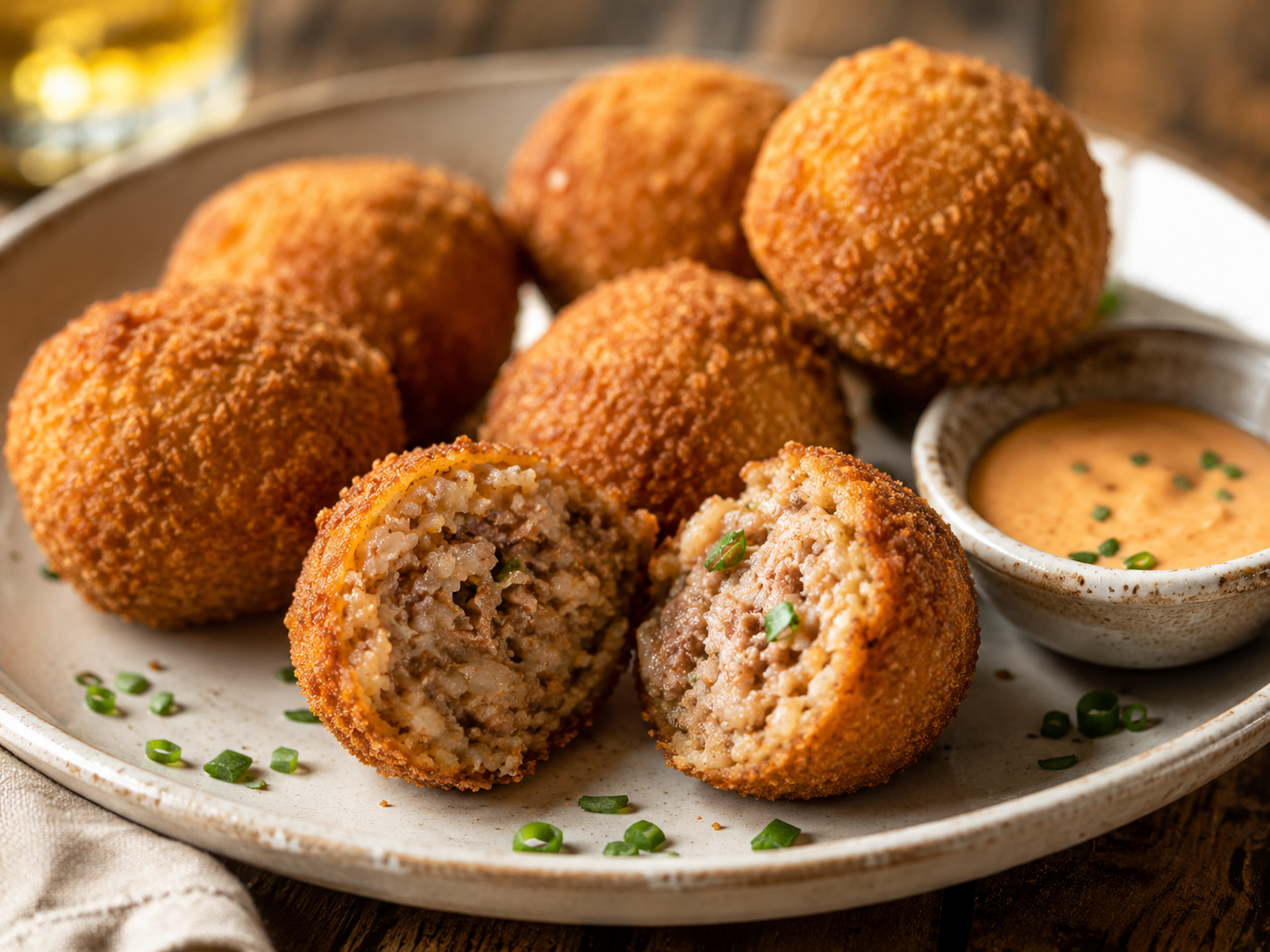
Boudin balls are portions of boudin-style filling formed into balls, usually breaded and fried. The result is a crisp exterior around a soft, seasoned meat-and-rice center.
The defining difference
A ball changes the structure, not just the shape.
A boudin link and a boudin ball can begin with a related filling, but they depend on different structures. A link relies on casing to contain the mixture. A ball relies on careful forming, breading, and exterior cooking to hold the portion together.
That transformation changes the eating experience. The link has a yielding casing around its filling; the ball introduces a dry, crisp shell before the soft center. See the broader family in the guide to types of boudin.
Boudin link
Casing holds the filling.
The exterior is part of the stuffed-link format and may stay soft, tighten, brown, or smoke depending on the finish.
Boudin ball
Forming and breading hold it.
The cooked crust becomes the outside structure and provides the contrast that defines the form.
Inside the crust
The center still belongs to the boudin family.
The center commonly combines cooked meat, rice, aromatics, seasoning, and enough moisture to remain tender. The exact formula varies, so the ball form does not identify one mandatory recipe.
Questions about the filling belong with the guides to what boudin is made of, why boudin has rice, and whether boudin has liver.
How the form comes together
Four structural steps define a boudin ball.
This is the form logic, not a home recipe. Detailed boudin production belongs in how boudin is made.
- 01
Prepare the filling
A cooked boudin-style mixture provides the meat, rice, aromatics, seasoning, and moisture that will become the center.
- 02
Portion and form it
The filling is divided and shaped into compact portions. The ball must hold together without being compressed into a dense center.
- 03
Build the exterior
A coating or breading creates the structure that casing provides in a link and prepares the outside to become crisp.
- 04
Cook the outside
Frying is the defining common finish: it browns and crisps the breading while warming the already-cooked filling. Baked and air-fried versions also exist.
Exterior and interior
Crisp outside, soft and savory inside.
A well-made ball gives a clear contrast. The coating should feel crisp and browned without becoming a heavy barrier. The center should remain moist, cohesive, and easy to bite through, with meat and rice still recognizable.
Flavor depends on the filling and finish. Continue with what boudin tastes like.
Common variations
The form stays recognizable while the filling changes.
Boudin balls are a category of preparation, not one fixed formula. These are useful descriptions of variation rather than separate types that require their own guides.
Pork
The familiar reference form, usually built around a seasoned pork-and-rice filling.
Crawfish or seafood
A related Louisiana variation whose filling shifts the flavor toward crawfish or another seafood.
Cheese-filled
Cheese may be folded into the mixture or placed at the center for a richer interior.
Spice and breading
Pepper level, crumb size, coating thickness, and seasoning change the crust and first bite.
At the table
Usually eaten as a self-contained portion.
Boudin balls are commonly served hot and eaten by hand, either on their own or with a dipping sauce. Their breaded exterior makes them easier to portion and share than loose filling.
For the broader serving customs, casing questions, and other formats, use the guide to how to eat boudin.