
Louisiana boudin terminology
Boudin Glossary
Direct definitions for the ingredients, textures, styles, and regional words used throughout Boudin.com.
Define here, explain elsewhere
The words behind the link.
Louisiana usage can change by family, maker, and community. These definitions clarify common meanings without forcing one recipe or tradition to represent every boudin.
A
- Acadiana
- A multi-parish region of South Louisiana strongly associated with Cajun communities, language, music, and foodways. Its boundaries are cultural rather than limited to one city or parish.Louisiana boudin and its regional context
- Alligator boudin
- A specialty boudin made with alligator, usually supported by fat, rice, broth, and seasoning to keep the lean meat moist.Alligator boudin
- Aromatics
- Flavor-building ingredients such as onion, green onion, celery, bell pepper, and garlic. The combination varies by recipe.
B
- Boudin
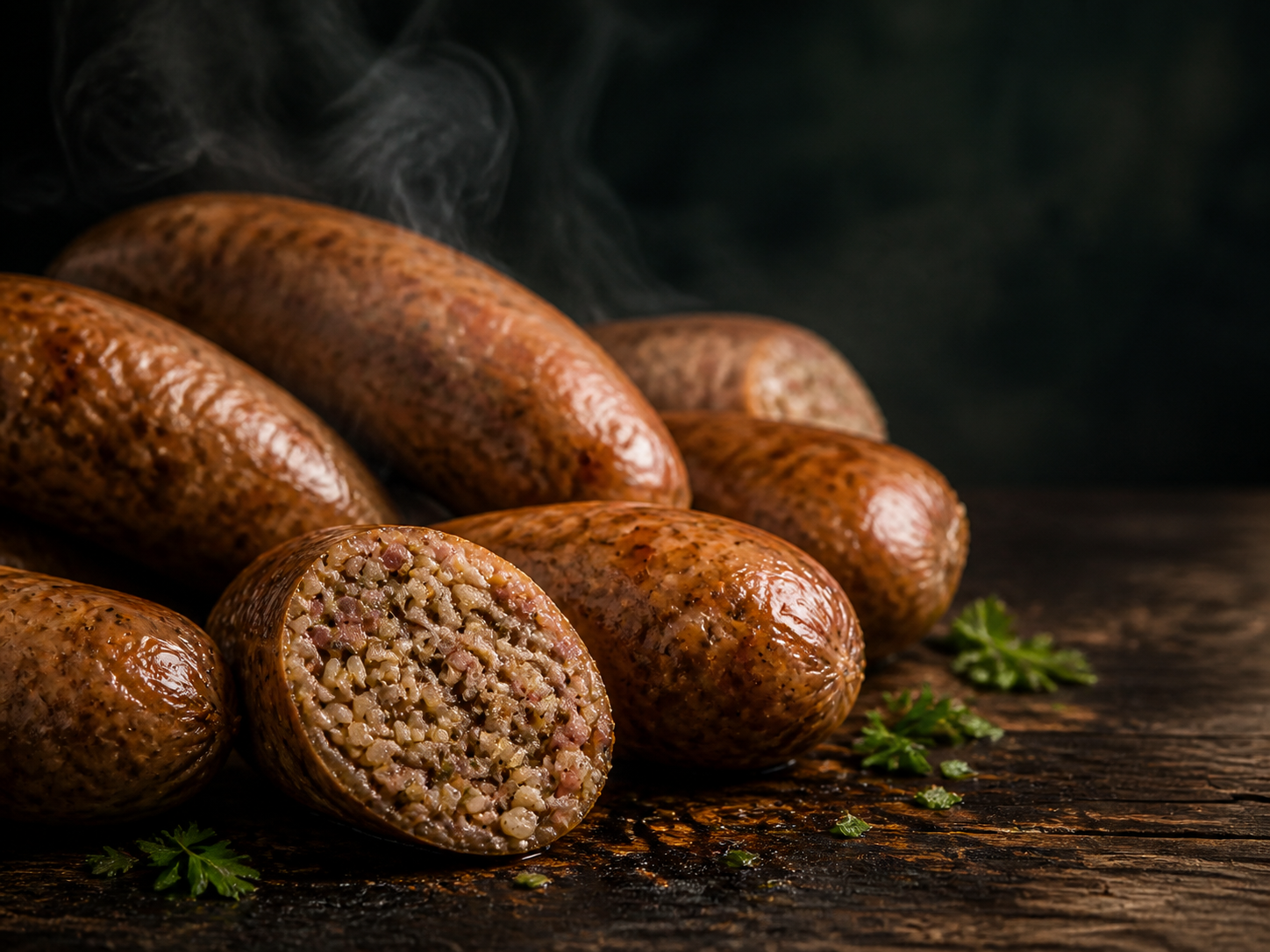
- In Louisiana usage, a seasoned mixture of cooked meat, rice, broth, and aromatics, commonly packed into a casing. Recipes, proteins, and textures vary by maker.What boudin is
- Boudin balls
- Portions of boudin filling formed into balls, typically breaded and fried until crisp outside. Some versions include cheese or another filling.Boudin balls
- Boudin blanc
- Literally “white boudin.” In Louisiana, the term may distinguish non-blood pork-and-rice boudin from boudin rouge; French boudin blanc belongs to a different sausage tradition and is not the same formula.
- Boudin rouge
- A blood-enriched Louisiana boudin style with historical roots. It is far less common today than familiar pork-and-rice boudin.
- Broth
- Seasoned cooking liquid mixed into boudin filling. It carries flavor, moistens the rice, and helps determine whether the filling is loose, creamy, or firm.
C
- Cajun
- A cultural term associated with descendants of Acadian settlers and the communities, language, and traditions that developed in Louisiana. Not every Louisiana food or resident is Cajun.
- Cajun boudin
- A broad name for the meat-and-rice boudin associated with Cajun South Louisiana. It describes a regional family of recipes rather than one fixed formula.Louisiana boudin
- Casing
- The outer tube that holds boudin filling. A casing may be natural or manufactured and may be eaten or removed depending on the product and personal preference.Boudin casing
- Coarse
- A texture with larger, more distinct pieces of meat, rice, or aromatics rather than a finely blended filling.
- Crawfish boudin
- A seafood boudin in which crawfish is the defining protein. Recipes may be buttery, herb-forward, peppery, or rich with crawfish flavor.Crawfish boudin
- Creamy
- A soft, cohesive filling texture created by the balance of finely worked meat, cooked rice, fat, and broth. It does not necessarily mean dairy is present.
- Creole
- A Louisiana cultural term with several historical meanings involving people, language, and food traditions. Cajun and Creole overlap in places but are not interchangeable labels.
F
- Fine
- A boudin texture in which meat and aromatics are ground or mixed into small, less distinct pieces.
G
- Green onion
- An aromatic used in many boudin recipes for fresh onion flavor and color. Its presence and amount vary by maker.
- Grind
- The size and consistency to which cooked meat and other ingredients are reduced before mixing. Grind strongly affects whether boudin feels coarse, fine, or creamy.
H
- Hot boudin
- Depending on context, boudin served warm or a recipe made with more chile heat. When it describes heat level, it belongs to the same broad style as spicy boudin.
L
- Liver
- An ingredient in many traditional pork boudin recipes that adds richness and a distinctive savory flavor. Some makers use a small amount, while others use none.
- Loose
- A filling whose grains and pieces separate readily rather than holding together as a dense paste.
- Louisiana boudin
- The family of meat-and-rice sausages and related preparations shaped by Louisiana ingredients, communities, markets, and cooking traditions. It is not identical to every international food called boudin.Louisiana boudin
M
- Meat-forward
- A tasting description for boudin in which the flavor or texture of meat is more prominent than the rice, broth, or aromatics.
- Meat market
- A butcher shop or specialty food store. In South Louisiana, many meat markets make and sell their own boudin, sausage, cracklins, and prepared foods.
- Moist
- A filling with enough broth and fat to feel juicy or tender without becoming watery. Moisture can change during storage and reheating.
N
- Natural casing
- A sausage casing made from cleaned animal intestine. It is generally edible and can become tender, chewy, or snappy depending on how the boudin is prepared.
P
- Pepper-forward
- A tasting description for boudin in which black pepper, cayenne, or other pepper flavor is especially noticeable. It does not always mean intensely hot.
- Pork boudin
- The traditional reference style of Louisiana boudin, usually made with cooked pork, rice, broth, aromatics, and seasoning. The cut of pork and amount of liver vary.
- Pork shoulder
- A flavorful pork cut with connective tissue and fat that can remain moist after cooking. It is one of several cuts a maker may use in pork boudin.
R
- Rice
- A defining ingredient in familiar Louisiana boudin. Rice absorbs seasoned broth, carries flavor, and helps create the filling's soft texture.
- Rice-forward
- A tasting description for boudin in which rice has a more noticeable presence in the flavor, texture, or meat-to-rice balance.
S
- Seafood boudin
- A broad category of boudin made with seafood such as crawfish or shrimp. Its seasoning, fat, moisture, and supporting ingredients vary by recipe.Types of boudin
- Seasoning
- The salt, pepper, herbs, spices, and aromatics that shape a boudin recipe. Heat level is only one part of seasoning.
- Shrimp boudin
- A seafood boudin in which shrimp is the defining protein, usually combined with rice, aromatics, seasoning, and enough moisture or fat to bind the filling.Shrimp boudin
- Smoke
- Flavor and surface changes produced by exposing boudin to wood smoke. Smoke intensity and the resulting casing texture vary by maker and method.
- Smoked boudin
- Boudin exposed to smoke after it is filled, usually giving the link smoke flavor and a firmer exterior. It may still need reheating according to the package directions.
- Smokehouse
- A building, room, or commercial operation used to smoke meat and sausage. Some Louisiana smokehouses also make fresh boudin and other regional foods.
- Snappy casing
- A casing that gives a clean, firm bite before yielding. Smoking, grilling, and casing material can all affect snap.
- South Louisiana
- The southern part of Louisiana, including but not limited to Acadiana and the New Orleans region. Boudin traditions are especially visible in many communities west of New Orleans.
- Spicy boudin
- Boudin made with a more assertive level of chile or pepper heat. “Spicy” and “hot” are relative labels, so heat varies by maker.
T
- Texture
- How the filling and casing feel when eaten. Grind, rice, broth, fat, mixing, casing, and cooking can make boudin coarse, fine, loose, creamy, moist, or firm.What boudin tastes like
Continue exploring
For the main definition, start with what boudin is. To compare recipe families, browse the types of boudin. What boudin is Types of boudin